
5 Paths to Achieving Financial Freedom Faster

Every Sunday, I send you something to THINK about, a question to ASK yourself, something to TRY and invite you to SHARE.
Want to advertise in this Newsletter?
Book HERE
THINK
Freedom is the oxygen of the soul.
Moshe Dayan
We previously explored How much you need to become Financially Free.
Put simply:
- Multiply your Annual Living Expenses by 25
- £20,000 (Annual Expenses) x 25 = £500,000 (Freedom Number)
- £40,000 (Annual Expenses) x 25 = £1,000,000 (Freedom Number)
“Oh, is that all I need Huw?” (said with bitter sarcasm)
These Financial Freedom numbers are vast and overwhelming. It’s like cleaning a Football stadium with a toothbrush.
Most people feel deflated (not motivated) when they look at them.
But fear not, my financial friend…
In today’s newsletter, I want to explore 5 paths to reduce your Financial Freedom number and speed up your timeline to achieve it.
1. Reduce Your Annual Expenses
“Oh, you’ve never mentioned this before Huw.” (Is that sarcasm again?)
I will never stop highlighting this point (even to the annoyance of some) because of the power of its influence to achieving Financial Freedom faster.
Let me quickly do my thing, and I promise we’ll cover areas you’ve overlooked or forgotten about in a moment.
Deal?!
Reducing annual expenses from £40,000 to £20,000 (not easy) means you need £500,000 less to become FF.
If you invest £500 /month at 7% Real Returns (accounting for inflation), that’s the difference between hitting your FF number in 28 years versus 38 years. 10 years of freedom!
I’m not suggesting you don’t spend your money.
I want you to be aware of the impact of living on less and to ‘Spend Wisely’.
Spend Wisely:
Buy things that make you more money, memories, time or healthier.
These products and services improve the quality of your life.
Avoid spending money on status.
It will decrease the quality of your life.
2. Workplace Pensions
How much do you have in your workplace pension?
Most people have no idea.
Many have workplace pensions unknowingly.
Check if you have one with your previous employers by using the Pension Tracer on Gov.UK HERE.
- Enter the names of your previous employers
- It will tell you who your pension provider is and who to contact
People find pensions worth £1,000s and even £10,000s that they had no idea existed.
How long would you work to earn £1,000 or £10,000? 2 hours?
Take a couple of hours to see if you have an unknown pot of gold sitting somewhere, waiting to be found.
If it comes up blank, at least you know.
If you find an old pension, you can consolidate it into one Personal Pension (SIPP).
- Don’t let it sit there unless it’s earning you at least 7% yearly.
- Many workplace pensions are too conservative (heavy bond and cash allocation) for people in their 20s to 40s. Having your money in 100% stocks is appropriate for most people until you’re 5-10 years from retiring. At this point, you’d increase your bond and cash allocation.
Maximise your Workplace Pension
Many employers offer generous pension contributions.
Does yours? Are you making the most of it?
In my previous job, my employer offered 5% contributions to my 2%.
- If I earned £2,000 pre-tax, I would contribute £40 to my pension, and my employer would contribute £100.
Speak to your line manager, HR or finance team to determine if your employer contributes to your workplace pension.
This is free money automatically invested. Compounded over time, this makes a big dent!
Factor in your Workplace Pensions
1. Add up the combined total of ALL your workplace pensions.
2. Estimate your future total using ‘Financial Freedom Planner’ (FFP) or a compound interest calculator.
- 100% stocks have historically achieved 10%.
- Using the FFP, I put in a £50k pension total, achieving 10% /year.
- I can estimate how much my pot will be worth by looking at the end value in the far right column.
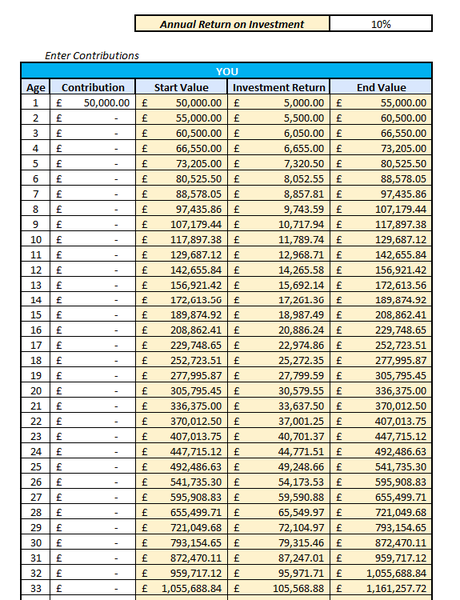
3. Take the estimated total away from your FF number:
- If I plan on retiring in 20 years, I can take my estimated workplace pension ‘End Value’ of £336,375 (see table above) and take it away from my FF number. (Adjust your timescales accordingly)
- Eg. £500k (FF number) – £336k (Workplace Pension Value in 20 years) = £164k (Shortfall)
If you plan to live on £20,000 /year in retirement. Facing a £164k deficit is far more encouraging than £500k.
But we’re not done yet…
Let’s chip away some more!
3. State Pension
Each country will have a different policy. For this section, I will focus on my country – the UK.
Adjust accordingly to your circumstances.
The full State Pension in the UK is currently £203.85 /week or £10,600.20 /year.
Find out how much you’re on track to receive and how you can ensure you receive the FULL amount by reviewing my guide HERE.
This won’t help those wanting to retire early (66 to currently qualify), and the government can always change their policy, but it’s a substantial amount worth factoring in.
- Multiply the annual amount by 25.
- Eg. £10,600.20 x 25 = £265,005
The FULL State Pension in the UK is the equivalent of having £265,000 invested in stocks (at 4% Safe Withdrawal Rate).
- Eg. £500k (FF number) – £265k (State Pension) = £235k (Shortfall)
This point is more encouraging the older you are.
For the whipper-snappers reading this, forget about this point and take comfort in having the additional years of compounding interest in ALL the other areas.
4. Rent Out a Room
Did you know that, at the time of writing, you can earn up to £7,500 tax-free by renting out a room or part of your home in the UK?
Check out the ‘Rent a Room Scheme’ by HMRC.
This won’t be feasible for everyone.
But if you can make it a reality by renovating a room, outhouse or garage for less than £100,000.
High ROI
You don’t have to complete a tax return if the income is below £7,500 /year.
A friend of mine converted their garage for £30,000 into a self-contained room. It had a kitchen, bathroom and lounge area.
Could you do something similar?
- £7,500 income on a £30,000 investment = 25% gross yield 😲
Even if it costs twice that amount to convert (£60,000), 12.5% is still an excellent annual return on a gross yield.
£7,500 /year is roughly equivalent to having £187,500 invested in stocks (@4% SWR).
- Eg. £500k (FF number) – £187k (Rent a Room Scheme) = £313k (Shortfall)
It’s not passive income but a substantial amount to factor into your FF number.
5. Part-Time Work
Tips 1-4 will get you closer to your FF number.
You cover any remaining shortfall with easy & enjoyable part-time work.
Many people have an unpleasant perception regarding work. They view it as something they ‘have to do’.
It doesn’t have to be that way…
The internet has changed everything. You can find a way to make money doing almost anything nowadays. It could be something you’d enjoy doing or in an industry you’re interested in.
That doesn’t have to be the case. You can opt for something close to home that’s low-stress and easy.
Most people don’t want to retire and do nothing, at least not for the long term. Work is more enjoyable when you do something you’re interested in, decrease the time spent doing it or reduce the stress surrounding it.
If you find or create a job that brings in an extra £5k to £20k a year working part-time, it’s the equivalent of having £125k to £500k invested in stocks (@4% SWR).
Utilising one or a combination of the four options can dramatically reduce your FF number and the time it takes you to get there.
You might be closer than you think.
Reflect and share this with someone.
ASK
“Which area could you explore to achieve Financial Freedom faster?”
Write down what comes to mind.
TRY
TRY
Here are 10 actions for you to take to achieve Financial Freedom Faster:
1. Calculate your Financial Freedom number (multiply your Annual Living Expenses by 25).
2. Play around with this calculation to see how much lower you could make by reducing your annual expenses by 10-30%.
3. Check the Gov.UK pension tracer to see if you have a pension with a previous employer.
4. Check to see if you’re maximising your current workplace pension.
5. Factor in ALL your workplace pensions’ estimated future totals to your FF number.
6. Check that you’re entitled to the full State pension (or equivalent in your country).
7. Factor in the full state pension to your FF number.
8. Check to see if you can earn up to £7,500 tax-free cash (a year) from renting a room or part of your home. Factor this income into your FF number.
9. How close are you to your FF number with your current investments and all of the above combined?
10. Would you be open to working part-time to cover the shortfall?
HIT REPLY and let me know if you made FF more achievable.
I read and reply to every email, and remember, I’m rooting for you!
Remember: Little by little, a little becomes a lot.
SHARE
Reply to this email and share how it went for you. Let me know if you’d prefer to remain anonymous.
SHARE your Financial Freedom findings with a friend.
SHARE this Newsletter with someone who’s financially frustrated.
SHARE your wins with me.
Lead from the front and inspire others to follow.
Have an awesome week!
Huw


