
Destroy Debt: Part 2 – 57 Tips to Destroy Debt Fast

Every Sunday, I send you something to THINK about, a question to ASK yourself, something to TRY and invite you to SHARE.
THINK
“You will either learn to manage money or the lack of it will manage you.”
Dave Ramsey
If you’re in Debt and want out, this post is for you!
Last week, in Part 1, we looked at the mindset people have around debt and how it traps them in a debt cycle. If you haven’t read it, I recommend checking it out before reading this.
Once you’ve locked down the mindset, everything downstream becomes easier.
This week, I’m going to share 57 Tips to eliminate debt as quickly as possible.
It won’t be easy but you’ve got this.
In today’s newsletter, I’ll show you how to:
- Calculate your ‘Debt-Free Date’ in minutes
- Pay less in interest
- Put more money in your pocket
- Destroy Debt as quickly as possible (57 tips)
I’m going to show you 57 ways to Destroy Debt. That’s on me.
But I need you to put in the work and make it happen.
Deal? 🤝
It’s time to put your ‘David Goggins Goggles’ on, tie up your ‘Bruce Lee Boots’ and button up your ‘Jocko Jacket’.
Warrior face paint is optional.
Let’s kill debt as quickly as possible.
Tip 1 – Calculate Your ‘Debt-Free Date’
We need to understand what we’re working with. It’s time to metaphorically ‘jump on the scales’.
If you have multiple debts, this can quickly become confusing.
I’ve created a free spreadsheet to help you with this, it’s called the ‘Debt Destroyer’. You don’t need to sign up for a list, anyone can access it. Download it HERE.
You don’t have to use it but it’ll make finding your ‘Debt-Free Date’ super-simple. Feel free to create/use something similar.
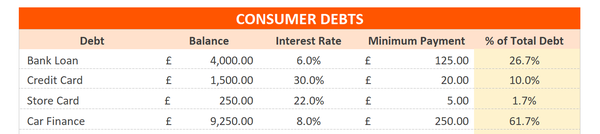
Get all of your debts down in one place. You’ll need the exact figures for:
- Outstanding balance
- Interest rate
- Minimum repayment
See the image below.
Add up the balance totals and minimum repayments, and calculate the average interest rate. (See below)

Input the amount you can afford to pay towards debt each month for now, along with the date you plan to start.
In this example, I’ve set the ‘Debt Destroyer’ at £400 /month (the minimum debt repayment), and starting payments in January 2024. (see below)

You’ll now be presented with a ‘Debt-Free Date’ on the right-hand side, along with the amount of interest you’ll pay in total under ‘Snowball Method’ and Avalanche Method’.
There are two main methods for eliminating debt. Both are equally effective.
- Debt Avalanche – Tackle the highest interest rate first. Mathematically, this is the optimal approach. You’ll pay your debts faster with this approach, but depending on your circumstances, it can be harder to face. If you’re prone to putting off overpayments, use the Debt Snowball.
- Debt Snowball – Tackle the smallest debt balance first to create momentum. This approach was created by Dave Ramsey to overcome procrastination and build momentum. Get a quick win by clearing the smallest debt, which leads you enthusiastically into the second smallest debt, and so on. If you struggle with the psychology of overpaying debt, this is a great option.
In our example, we have £15,000 of debt. The difference is £20 in interest payments and 1 month longer to become debt-free (see below). It’s negligible really. Don’t overthink it. Just pick one.
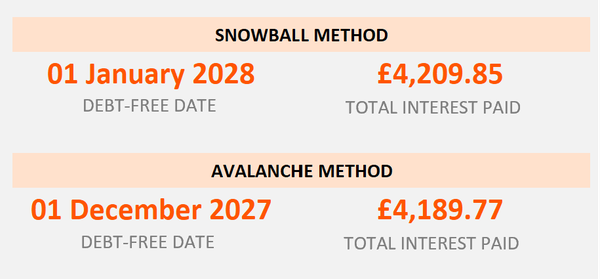
Make a note of your ‘Debt-Free Date’ because we’re going to smash it!
When you start to implement the tips below and see the ‘Debt-Free Date’ and Total Interest Paid’ reducing, you’ll be rewarded with hits of dopamine, which will fuel you to continue.
Tip 2 – Invest in Overpayments
Overpayments are investments and they dramatically move the needle.
If you’re overpaying 9.9% on car finance or 29% on a credit card, see it as though you’re ‘investing’ at 9.9% or 29% respectively and getting a guaranteed return at that rate.
You can’t get fixed returns like this in the stock market, which is why we should prioritise overpaying our high-interest debt before investing in stocks.
Q. “But you say we can get 10% returns in the stock market, and my debts 8%. Wouldn’t I be better off investing?”
A. Looking back at historical data, the annualised returns of the stock market are at 10% levels, but that’s averaged out over the long term. From year to year, it fluctuates.
One year it might be 20%, the next year it might be -10%. That’s a 10% average over 2 years. You don’t want to risk investing in a low-performing year when a reasonable guaranteed one is right in front of you.
Overpaying debt offers you an opportunity to get good guaranteed returns. Take them.
In our example, the person is paying the minimum repayments at £400 /month. It’s going to take them 4 years to clear the debt, and they’ll pay roughly £4,200 in interest.
If we increased debt repayments to £600 /month (£200 of overpayments), it would look like this…
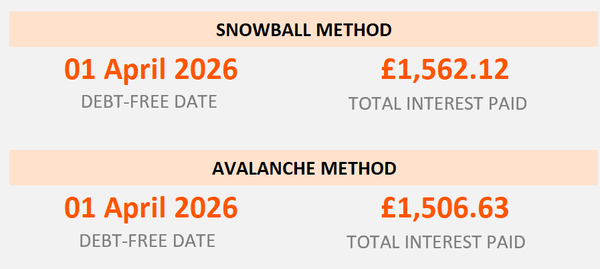
That would save at least £2,647 in interest payments and clear the debt 20 months earlier. 😮
That’s £2,647 in their pockets, rather than the finance companies and almost 2 years of freedom.
Let’s turn our focus away from the ‘Debt Destroyer’ and work on increasing our disposable income to fund our overpayments.
Tip 3 – Emergency Mode
We covered this in Part 1 but we need to be reminded more than we need to be taught, so it’s worth repeating…
The foundational principle behind killing debt is a sense of URGENCY.
Do not tolerate paying £1,000’s to finance companies with expensive interest, when you could be investing that money and providing for your family instead.
The simple rule I like to go by is:
All spending beyond food, getting to and from work, and essential house bills is banned until you become debt-free.
This is hard but if you adopt this philosophy, you’ll become debt-free in no time and you’ll learn a lot from the process.
Tip 4 – Keep the Essential and Lower the Cost
For me, the gym is essential. It helps me physically, mentally and emotionally.
It’s non-negotiable. I’m miserable without training.
However, if I have a £150 /month David Lloyd membership, I’d consider getting a £29 /month local alternative, or workout at home for free until I was debt-free.
It’s up to you to decide what’s essential.
I invite you to expand your horizons and be honest with yourself.
Keep the things that provide true value to your life and challenge yourself to find a free or lower-cost alternative for now.
Remember, this decision is temporary and you can return to your lovely lifestyle when you’re debt-free.
Tip 5 – Start an Emergency Fund
A lot of people ask me, “Should I use an emergency fund to clear my debt?”
I like Dave Ramsey’s approach.
- If you have consumer debt, save £1,000 as fast as you can for emergencies and put everything else into paying down your debt.
- If you have £5,000 in savings, use £4,000 to pay down debt (we cover this in Tip 32) and keep £1,000 for emergencies.
This should cover you for most unexpected life events for now.
Once you become debt-free, you can build your Emergency Fund up to 3-6 months of living expenses.
Tip 6 – Eliminate, Switch or Negotiate
Lowering your expenses is the fastest way to increase disposable income, and increase debt overpayments.
Look back through your past 12 months of bank statements and highlight every expense that leaves your current account and ask:
“Can I eliminate, switch or negotiate this expense?”
Tip 7 – Become a Playboy
You should act like a ‘Playboy’ when it comes to paying bills. Zero loyalty! Go to the lowest charging provider each time your fixed term ends.
I worked in sales for a decade, and I can confirm that companies make the most money from loyal customers. It’s sad but true.
They make the least profit and even lose money to acquire new customers.
Be a new customer or speak to them and demand a lower rate for your loyalty.
Always be willing to walk.
Tip 8 – Start with Effortless Wins
When you’re wearing your Hugh Hefner robe, start by focussing on the Effortless Wins.
We all have to pay for house bills, transport and food (the Big 3), whether we like it or not. We might not be able to eliminate them, but we can pay less for the same service, making it an ‘Effortless Win’.
You should be able to find significant savings here without altering your life too much, if at all. Once you’ve made progress with the easy wins, you’ll be fuelled to tackle the more challenging tips later on.
Tips 9-40 focus on saving your money the easy way.
Tips 9-14 – Reduce House Bills
Find a way to pay less for the same outcome. House Bills usually offer the greatest potential savings. Here are the main things to consider:
- 9) Mortgage – Make sure you’re on the best mortgage deal.
- 10) Electric & Gas – Compare energy providers.
- 11) Water – Consider if a water meter will save you money.
- 12) Council Tax Band – Check if your house is in the correct council band
- 13) Childcare – Can you qualify for financial support on childcare (all ages!).
- 14) Broadband – Compare broadband providers.
Tips 15-23 – Reduce Transport Costs
Motor vehicles are expensive to buy, run and maintain. Here are some ways to reduce their impact:
- 15) Eliminate Vehicles – The simple (not easy) solution is to eliminate them altogether. No insurance, no tax, no fuel, no MOT and no maintenance. Lovely!
- 16) Reduce Vehicles – If elimination is too much, try reduction. Can you go down to a one-car household?
- 17) Walk or Bike to Work – If you’re adamant about keeping your vehicles, can you use them less and use muscle power instead to reduce running costs?
- 18) Lift Share – Team up with a colleague and split the transport bills.
- 19) Use Less Fuel – Drive more efficiently.
- 20) Pay Less for Fuel – Find cheaper fuel locations.
- 21) Reduce Car Insurance – Compare Insurance providers every year.
- 22) Pay Annually – Save money by paying for car insurance and car tax in full every year. If it costs £120, save £10 a month into an ‘Annual one-off Spending Account’, and pay for it in full 12 months later.
- 23) Cheaper Breakdown Cover – Pay less for breakdown cover.
Tips 24-31 – Reduce Food Costs
We all need food to survive and Supermarkets are experts at making us spend money. Here are some tips to reduce their influence over us:
- 24) Shop Online – You can save money on Food by shopping online (reduce impulse buying).
- 25) Create a List – Counter enticing sales tactics by creating a list and keeping to it. This is even easier when you do it online.
- 26) Don’t Shop Hungry – Your willpower is non-existent when hungry. You spend more on unnecessary items when you’re hungry.
- 27) Meal Planning – Plan what you’re going to eat every evening and buy food in advance to cater for it. It irradicates decision-making and helps eliminate food waste.
- 28) The Same for Less – Change supermarkets (Waitrose and M&S → Aldi and Lidl).
- 29) Downshift Challenge – Supermarkets separate their products into different categories – Premium (’Extra Special’, ‘Finest’), Branded (Heinz, Kellogg’s), Own Brand (Supermarket branded alternative) and Value (’Basic’, ‘Savers’). Try going down one brand level on everything and see if you can tell the difference. If you can, go back up. If not, stick with the cheaper option. This can save you up to 30% on food bills. I found that I couldn’t tell the difference for 3/4 of the downshift, and I kept Premium for 1/4.
- 30) Buy in Bulk – Buy items in bulk when at a discount. This is a no-brainer for non-perishables.
- 31) Packed Lunches – Save on food costs by taking packed lunches to work and for days out with the family.
Tip 32 – Use Savings to Kill Debt
Debts usually cost more than savings earn in interest. When you eliminate the debt, you’re usually better off.
The banks LOVE people who are in debt and have savings. They make money from loaning you money and charging at 10-30%, whilst paying you 1-4% in interest on savings.
They profit from the difference.
- Use low-rate savings to pay down high-rate debt.
- Keep £1,000 in your savings for an emergency fund and use the rest.
There are only 2 exceptions to this rule:
- The interest on your debt is cheaper than your savings interest – If you locked in a loan at 3% and your savings account is 4%, then it makes sense to pocket the difference and not pay down the debt.
- You’ll receive a penalty for overpaying – If overpaying or clearing your debt early results in a penalty, leave the cash in your savings until the penalty expires or is smaller than the savings you’d get from overpaying. Find out with this Free Calculator.
I know that psychologically this is difficult to do, but you must consider your Net Worth (assets minus liabilities), monthly cashflow when you don’t have to pay for debt and the psychological freedom you’ll get from becoming debt-free faster.
- Net Worth – People ‘feel’ richer for having money in savings but your net worth is what you have minus what you owe. When you do this calculation, you’re usually better off clearing the debt and saving the additional cashflow next month.
- Monthly Cashflow – Don’t discount how great it feels to get extra disposable income each month. You can use this to save, invest and live life.
- Freedom – Freedom is the only condition for happiness. With debt, you’re not free. Killing it creates a wonderful sense of freedom and satisfaction.
Tips 33-37 – Reduce Debt Costs
You need to TREAD WITH CAUTION with the following tips. ⚠
If you use financial discipline, it’s possible to reduce your debt repayments by considering cheaper lending options but you need to be rational and honest with yourself.
If you can switch your existing borrowing onto a cheaper alternative, you can save £100s or £1,000s a year on interest payments. The additional cashflow will afford you to make larger debt overpayments and move you closer to becoming debt-free.
There’s one Key Rule:
ONLY BORROW ENOUGH MONEY TO PAY DOWN DEBT. NO MORE.
If in any doubt, don’t do it.
- 33) Clean Credit Rating – Check your credit rating for free and remove any false data to enhance your likelihood of future applications.
- 34) Always Check Eligibility – Before applying for a lower-rate Credit Card or Loan to reduce your debt costs, make sure you do an eligibility test first (Credit Card Eligibility and Bank Loan Eligibility). These are ‘soft searches’ which won’t impact your credit score.
- 35) 0% Balance Transfer Card – Consider transferring your credit card debt to a Balance Transfer Credit Card at 0% Interest. You usually have to pay around 3% to transfer (£30 for every £1,000 in debt) but this can save you money if you’re paying over 20% interest (£200 /year for every £1,000 in debt). These cards are for transferring debt, not spending money. If you use them to purchase goods you could be hit with charges and interest.
- 36) Bank Loan – If you don’t qualify for a 0% Balance Transfer Credit Card, the next option could be a Bank Loan. Only borrow the amount of your debt, pay off your higher-rate debt and you’ll be left with lower monthly repayments. BE RESPONSIBLE AND TREAD WITH CAUTION!
- Rates currently range from 6-15%. If you’re paying more for your debt, you might be better off getting a bank loan, BUT…
- Only borrow the amount you need to pay off the expensive debt – NO MORE!
- Commit to paying it off as quickly as possible.
- If there’s any doubt or you feel uncomfortable, don’t do it.
- Be responsible!
- 37) Negotiate Your Rate – If you don’t qualify for a 0% credit card or Loan, ask your creditors to lower the rate. They can and do this! Don’t wish and wonder, find out. You have nothing to lose.
Tip 38 – Working From Home
If you worked at home during one of the lockdowns, even for a single day, you’re entitled to claim a tax rebate. This could be as much as £140 a year for 20/21 and 21/22 tax years.
Here’s a guide on how you can claim retrospectively.
It won’t change the world, but it’s better than a kick up the arse. 🥾🍑
Put it towards a debt overpayment.
Tip 39 – Uniform Tax Rebate
If you wear a uniform for work, you might be eligible for a tax rebate. You can claim for up to 5 years worth of expenses for washing, replacing or repairing your uniform.
This isn’t restricted to public sector work. If you wear branded clothing you can qualify.
Find out for free if you qualify here.
Tip 40 – Entitled to Benefits?
The government offer support to those with children (all ages), care responsibilities, health issues and even for those working but still struggling financially.
Millions of people are missing out on unclaimed benefits (£19 Billion 😮), so it’s worth working through this guide to see if you’re eligible.
It’s free and it’ll only take 10 minutes.
Tip 41 – This is Temporary
Once you’ve exhausted your easy wins, it’s time to move on to the more challenging options – the non-essentials.
This is where most people struggle. Cutting back on lifestyle costs seems like a restriction of freedom.
But debt is the anchor truly restricting you.
Fighting to release the ‘ball and chain’ is harder than just walking with it, but trust me, the effort is worth it. I invite you to step outside your comfort zone, challenge yourself and unshackle the chain.
Walking without it is true freedom.
- This is Temporary – Any decision you make can be reversed. Go without something for a week, month or year and experience the impact. Most people avoid elimination due to the perceived pain they’ll experience. In most cases, it’s not only painless but beneficial. Stop guessing. Try for yourself and find out.
If you tried living without it, and your well-being truly suffered, you can always go back to it.
Tip 42 – Get it for Less
You don’t have to eliminate something that provides value to your life.
Can you get the same or 80% of the outcome for less?
Look for cheaper temporary alternatives.
Businesses can also be very understanding. If you tell them you’re in debt and looking to get out of it, they might reduce the price, give you a payment holiday or help in some other way.
You have nothing to lose by asking.
Tip 43 – Cancel Subscriptions
Cancel all subscriptions and use the time you’d be sitting in front of screens to talk, connect, work out, walk, talk to friends, hang out with family, play games, play cards, do art, journal, read, etc.
Keep referring back to Tips 41 and 42.
Try living without it for a month. Was it really that bad?
If it’s too much to consider, try cancelling half of them.
You can always reinstate them when you’re debt-free.
Tip 44 – Avoid Temptations
Alcoholics should avoid bars, shoppers should avoid shops and I should avoid chocolate biscuits.
What’s your vice?
I LOVE chocolate biscuits. My mum buys them for me when I go back home although I ask her not to. I take 3 out of the packet for my cup of tea. Within seconds, I’ve inhaled them and I have another 3 in my hand. “What the…”
Then they quickly disappear and I hate myself.
So, I reach for another 3 to make myself feel better. It doesn’t work.
What just happened? 🤷♂️
We don’t have chocolate biscuits in our house because I’m an addict and I’ll eat the entire bag and fight anyone who even looks at them.
James Clear (’Atomic Habits’) tells us to make a Bad Habit – Invisible, Unattractive, Difficult and Unsatisfying. I find ‘Invisible’ and ‘Difficult’ most helpful.
- Invisible – Out of sight, out of mind.
- Difficult – Make it so difficult, you give up.
Stay away from the things that ‘make’ you spend money.
Don’t rely on willpower.
Tip 45 – Leave Your Money at Home
You can’t spend money you don’t have.
In relation to Tip 44, make it harder to spend by leaving your wallet/purse at home. That way, you can’t spend money.
It’s harder nowadays with Google and Apple Pay, but there is a solution…
I know it sounds insane, but you could leave your mobile at home. 🤯
And if you’re lucky, just like in the 1990s, you might not die.
Tip 46 – One In, One Out
If there is something you really want to buy that isn’t a necessity, allow yourself the opportunity to buy it IF you sell an item for the same amount.
This creates a healthy mindset around spending by reducing impulse purchasing, it cultivates appreciation and removes guilt around consuming.
Tip 47 – Consider The REAL Cost
Saving £100 /month doesn’t just save you £1,200 /year. If you were able to invest that money at 10% returns, it’ll be worth so much more in the future:
- £20,655 = 10 years
- £76,569 = 20 years
- £227,932 = 30 years
Is it worth it? 🤷♂️
Put the annual expense into a compound interest calculator and see what you could have in the future instead.
Tip 48 – Easy Employment
Reducing your expenses will only take you so far. At some point, you’ll reach diminishing returns on your effort – ie. Spending 2 hours to save £2.
Once you’ve controlled your spending, turn your attention to earning more. It has far more potential to increase your disposable income, and now that you’ve controlled spending, you’ll get to keep that extra cash, which you can use to eliminate debt.
A great place to start is with your current role. You’re already generating income there. Can you earn more?
- Can you work extra hours?
- Earn extra commission or bonuses?
- Can you apply for a promotion or work towards one?
- Could you ask for a raise?
- Have you considered working for a competitor? You could get paid more for doing the same job.
Tip 49 – Part-Time Work
Is there something you’re open to doing part-time? Can you monetise your knowledge, skills and experience?
It could be related to your employment or something totally different.
It’s never been easier to make money online doing any number of things.
- Consider working evenings, weekends, a couple of times a month, one-off tasks or even seasonal.
I’ve written a guide on Finding the Perfect Side Hustle in 6 Steps, which helps you hone in on the right money-maker for you.
Tip 50 – Sell Stuff
Are there items lying around your house that you don’t use anymore?
List them to eBay, Gumtree or a local Facebook marketplace and cash them in. You’ve already paid for the item, so this is all profit.
You can generate £100s and even £1,000s that you can use to overpay debt. It’s also very satisfying to declutter.
My rule of thumb:
If you haven’t used an item in 2 years, get rid of it.
Tips 51-54 – Rent Stuff
Could you rent out things that you own to generate income?
There are loads of options here, here are just a few to get your juices flowing:
- Rent out a room or part of your home – At the time of writing, you can earn up to £7,500 /year tax-free. List your room on AirBnB, Spareroom or Openrent.
- Rent your parking space – If you don’t use your parking space at home, rent it out for an easy profit on platforms like Your Parking Space or Justpark.
- Rent your vehicle – List your car on Hiyacar or Getaround. You can connect with potential renters and earn money by renting out your car for a specific period.
- Spare Storage Space – Do you have spare unused storage space? You can earn money on the side by helping others store their belongings on Stashbee or Storemates.
Tip 55 – You’re Not Alone
Are you struggling with the mental burden of Debt?
It can put a huge amount of pressure on people to the extent it’s difficult to cope.
I love Alex Hormozi’s saying, “Outwork your self doubt.”
I promise that if you work through all of the tips within this newsletter, you will feel better about your situation and you will make progress but for some, it’s not enough.
You’re not alone. 🧡
If you’re struggling mentally with your debt, there are charities out there whose sole purpose is to help you for free:
- Get 1-to-1 counselling or support.
- Access to the ‘Breathing Space’ scheme – A 2-month break from interest payments without repercussions from creditors.
- Help to negotiate with creditors.
- Create a budget or action plan.
Here’s a list of some of the charities that can help:
- Citizens Advice – Full debt and consumer advice service
- StepChange Debt Charity – Create a budget and personal action plan with practical next steps
- National Debtline – Free advice and resources to help people deal with their debts
- Civil Legal Advice – Legal advice on a small range of issues, including debt where your home is at risk.
- Business Debtline – Provides free advice and resources for both business and personal debts.
- PayPlan – Free debt advice and solutions. It’s a private company, but the advice is free.
- Samaritans – If you’re feeling struggling to cope with your situation, this charity is always there to listen and help.
You’re not alone. 🧡
Tip 56 – Avoid Debt Consolidation
Don’t be tempted to sign up for debt consolidation ads you see online, on TV or in local newspapers.
These companies are businesses. Businesses need to make a profit. You are the profit.
They can and will reduce your monthly repayments by consolidating your debt into one payment, which appears to solve your problems, BUT it will cost you in the long run.
There’s no such thing as a free lunch. Avoid them.
Here’s why:
- Fees and Costs – They add Fees and Costs to the total balance, extending what you owe.
- Limited Impact on Principal – You pay less on the principal so end up being in debt for longer, and paying more in interest over the long term than you would have without it.
- Credit Score Impact – It will negatively impact your credit score.
- Risk of Scams – Some debt consolidation companies may be unscrupulous and engage in fraudulent or deceptive practices.
Focus instead on doing what you can to work through this Newsletter and only work with people who aren’t financially incentivised to keep you in debt, like the charities in Tip 55.
Tip 57 – Never, Ever, Ever Give In
Destroying Debt isn’t easy, and at times it might get the better of you.
That’s OK, you’re human.
Don’t beat yourself up for past decisions or compare your debt to others.
Focus on you, today.
Are you doing what you can today to lower your debt?
If so, take comfort in that.
If you keep working through these tips and chip away at your debt, you will get there. I promise.
Commit to killing debt and don’t stop swinging until you do.
In the words of Jocko Willink:
“If you can say the word “debt”, then guess what…. it means you’re still alive, it means you’re still breathing.
And if you’re still breathing. Well then hell, you’ve still got some fight left in you.
So get up, dust off, reload, recalibrate, re-engage and go out on the attack.”
Kill that debt.
As fast as possible.
Reflect and share this with someone.


